Wrapping a curve with holes adds holes as fast as freedom穴のある曲線は、巻きつけるほど穴も増える
Seriesシリーズ · Part 8 of 178 / 17
All parts ↓すべての回 ↓Bend-and-Shatter, made simpleやさしい Bend-and-Shatter
Goal: ゴール:Learn how one movable curve tells you which simple curves fill a space, and why the best bound is n + 1.動ける曲線 1 本から、空間を編む単純な曲線を言い当てるしくみと、上限が n + 1 になる理由を知る。 Why it’s interesting →なぜ面白いのか →
In one lineひとことで
Over the complex numbers, wrapping a curve can’t turn a negative knob estimate positive.
Part 7 gave the paper’s estimate: knobs ≥ −K·C + n(1 − g). For a curve with many holes, this can be zero or negative, which guarantees nothing. One natural fix is to wrap the curve around itself several times. Going around C k times multiplies every crossing count by k, so −K·C becomes k times larger.
Start with a curve with no holes. Over the complex numbers, it is a sphere (Part 5), and a sphere can be wrapped for free: t ↦ t^k wraps it around itself k times. The wrapped curve still has no holes, so the estimate grows to k(−K·C) + n.
A curve with holes can’t. To go around C k times, you need another curve C′ that lies over C k times, and C′ has more holes than C. Triangles show how many more. Cut C into triangles and count vertices − edges + faces: the result is always 2 − 2g. C′ is made of k copies of each triangle, so its count is k times as large, or smaller if C′ has to branch. That gives g′ ≥ k(g − 1) + 1.
Put that into the estimate: k(−K·C) + n(1 − g′) ≤ k × (−K·C + n(1 − g)). After wrapping, the estimate is at best k times what it was before. Holes grow exactly as fast as −K·C does.
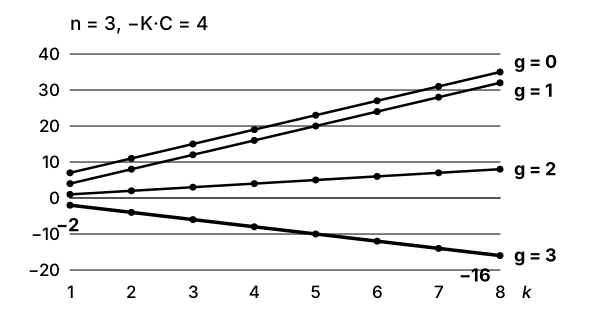
Here is an example with n = 3. Take a curve with g = 3 and −K·C = 4. Its estimate is 4 + 3 × (1 − 3) = −2. Wrap it 8 times: −K·C becomes 32, but C′ has at least 8 × 2 + 1 = 17 holes. The estimate is at most 32 + 3 × (1 − 17) = −16, which is 8 × (−2). Wrapping made it worse.
So over the complex numbers, wrapping only helps a curve whose estimate is already positive. A curve with one hole is fine: g′ = 1, and the estimate k(−K·C) grows. The trouble starts at two or more holes, when −K·C ≤ n(g − 1). Part 9 shows how Shigefumi Mori got past this wall in 1979.
References参考資料
In one lineひとことで
複素数では、曲線を巻きつけても、負のつまみの見積もりは正になりません。
第 7 回で、論文の見積もり「つまみ ≥ −K·C + n(1 − g)」を見ました。穴の多い曲線では、これが 0 以下になり、何も保証されません。すぐ思いつく手は、曲線を何周も巻きつけることです。C を k 周なぞると、交わる回数はどれも k 倍になります。だから −K·C も k 倍になります。
まず、穴のない曲線で試します。穴のない曲線は、複素数で見ると球です(第 5 回)。球なら、ただで巻きつけられます。t ↦ t^k で、球を k 周巻きつけられます。巻きつけた曲線も穴がないままなので、見積もりは k(−K·C) + n に増えます。
穴のある曲線では、そうはいきません。C を k 周なぞるには、C の上に k 枚重なる別の曲線 C′ が要ります。この C′ は、C より穴が多くなります。どれだけ多いかは、三角形で数えられます。C を三角形に分けて「頂点 − 辺 + 面」を数えると、いつも 2 − 2g になります。C′ は C の三角形を k 枚ずつ重ねたものなので、この数は k 倍になります。C′ が枝分かれすると、もっと小さくなります。ここから g′ ≥ k(g − 1) + 1 が出ます。
これを見積もりに入れると、k(−K·C) + n(1 − g′) ≤ k × (−K·C + n(1 − g)) です。巻きつけたあとの見積もりは、よくても巻きつける前の k 倍です。−K·C が増えるのと同じ勢いで、穴も増えるからです。
例で確かめます。n = 3 の空間で、穴が g = 3 個、−K·C = 4 の曲線を考えます。見積もりは 4 + 3 × (1 − 3) = −2 です。8 周巻きつけると、−K·C は 32 になります。でも C′ の穴は、少なくとも 8 × 2 + 1 = 17 個です。見積もりは多くても 32 + 3 × (1 − 17) = −16 で、8 × (−2) と同じです。巻きつけて、かえって悪くなりました。
つまり複素数では、巻きつけが役に立つのは、見積もりが最初から正の曲線だけです。穴 1 つの曲線なら g′ = 1 のままで、見積もり k(−K·C) は増えます。困るのは、穴が 2 つ以上で、−K·C ≤ n(g − 1) のときです。森重文さんが 1979 年にこの壁をどう越えたかを、第 9 回で見ます。