Pinning a curve at one point uses up n of its knobs曲線を 1 点で留めると、つまみが n 本へる
Seriesシリーズ · Part 4 of 174 / 17
All parts ↓すべての回 ↓Bend-and-Shatter, made simpleやさしい Bend-and-Shatter
Goal: ゴール:Learn how one movable curve tells you which simple curves fill a space, and why the best bound is n + 1.動ける曲線 1 本から、空間を編む単純な曲線を言い当てるしくみと、上限が n + 1 になる理由を知る。 Why it’s interesting →なぜ面白いのか →
In one lineひとことで
Each pin costs as many knobs as the space has dimensions.
Part 3 counted a family’s knobs: the numbers that pick out one curve. The paper doesn’t only move curves freely. It holds some of their points in place while the rest moves. In this series, holding a point in place is called pinning it.
Take the curves in the plane drawn by a number t with these formulas:
x = a0 + a1 t + a2 t², y = b0 + b1 t + b2 t²
The six coefficients are the knobs. Each setting draws one curve.
Now pin the point at t = 0 to the spot (1, 2). Putting t = 0 into the formulas gives x = a0 and y = b0, so the pin says a0 = 1 and b0 = 2. Two knobs are now fixed, and four are left. Every curve the four can still draw passes through (1, 2).
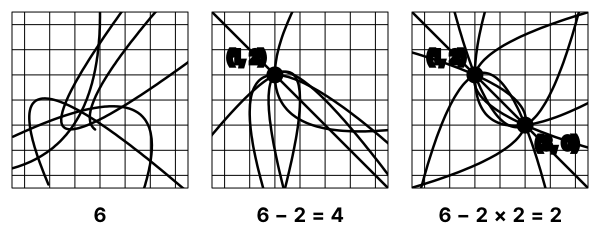
A second pin sends the point at t = 1 to (3, 0). It says a0 + a1 + a2 = 3 and b0 + b1 + b2 = 0. That fixes a1 and b1, and two knobs are left.
Each pin cost two knobs because the plane has two coordinates. As Part 2 showed, naming one spot in n-dimensional space takes n equations, one per coordinate, and each equation uses up at most one knob. So each pin costs n knobs: two in the plane, three in 3-dimensional space. After k pins, a family keeps at least (its knobs − n × k).
The paper uses this exact count. In the proof of its Proposition 2.2, fixing where one point of the curve goes lowers the family’s dimension by at most the dimension of X.
Pins matter because a pinned curve that still has knobs left must move while its pins stay put. From Part 10 on, that is what makes it bend and break. But pins are expensive. In the example, a third pin would use up the last two knobs, and the curve couldn’t move at all.
References参考資料
In one lineひとことで
ピン 1 本で、空間の次元と同じ本数のつまみが使われます。
第 3 回では、族のつまみを数えました。曲線 1 本を決める数のことです。論文は、曲線をただ自由に動かすだけではありません。曲線のいくつかの点を動かないように留めて、残りを動かします。このシリーズでは、点を留めることを「ピンで留める」と呼びます。
平面の曲線を、数 t を使った次の式で描きます。
x = a0 + a1 t + a2 t²、y = b0 + b1 t + b2 t²
6 つの係数が、つまみです。つまみを決めるごとに、曲線が 1 本描けます。
では、t = 0 の点を、場所 (1, 2) にピンで留めます。式に t = 0 を入れると、x = a0、y = b0 です。だからこのピンは、a0 = 1、b0 = 2 と同じです。つまみが 2 本決まり、残りは 4 本です。残りの 4 本でどう描いても、曲線は必ず (1, 2) を通ります。
2 本目のピンで、t = 1 の点を (3, 0) に留めます。式は a0 + a1 + a2 = 3 と b0 + b1 + b2 = 0 です。これで a1 と b1 が決まり、つまみは 2 本残ります。
ピン 1 本でつまみが 2 本へったのは、平面の座標が 2 つだからです。第 2 回で見たとおり、n 次元の空間で 1 か所を言い当てるには、座標ごとに 1 本ずつ、式が n 本要ります。式 1 本で、つまみは多くても 1 本へります。だからピン 1 本で、つまみは n 本へります。平面なら 2 本、3 次元なら 3 本です。ピンを k 本打っても、族には少なくとも「つまみの本数 − n × k」本が残ります。
論文も、この数え方をそのまま使います。命題 2.2 の証明では、曲線の 1 点の行き先を固定すると、族の次元は多くても X の次元だけ下がります。
ピンが大事なのは、つまみが残っている曲線は、ピンを留めたまま動くしかないからです。第 10 回からは、これが曲線を曲げて、折ります。ただ、ピンは高くつきます。この例で 3 本目のピンを打つと、最後の 2 本のつまみも使い切り、曲線はまったく動けなくなります。