A curve’s freedom grows with −K·C and shrinks with every hole曲線の動ける余地は、−K·C で増え、穴で減る
Seriesシリーズ · Part 7 of 177 / 17
All parts ↓すべての回 ↓Bend-and-Shatter, made simpleやさしい Bend-and-Shatter
Goal: ゴール:Learn how one movable curve tells you which simple curves fill a space, and why the best bound is n + 1.動ける曲線 1 本から、空間を編む単純な曲線を言い当てるしくみと、上限が n + 1 になる理由を知る。 Why it’s interesting →なぜ面白いのか →
In one lineひとことで
Each hole in a curve costs n knobs, the same as one pin.
Part 4 showed that each pin uses up n knobs, where n is the dimension of the space. The paper wants many pins, so it needs to know how many knobs a curve has. Part 3 counted the coefficients of an equation, but that only works for curves we can write down. The paper uses one estimate that works for any curve C:
knobs ≥ −K·C + n(1 − g)
Here g is the number of holes in C (Part 5). −K·C is counted like a size in Part 6, but with a special ruler −K that comes with the space itself. For example, take projective space: n-dimensional space with points at infinity added, so that parallel lines meet (Part 15). There, −K counts n + 1 times what a flat ruler counts, so a line has −K·C = n + 1.
The estimate has two parts. −K·C adds knobs: the larger it is, the more room the curve has to move. n(1 − g) gives a curve with no holes n extra knobs, and takes away n for every hole. So one hole costs as many knobs as one pin.
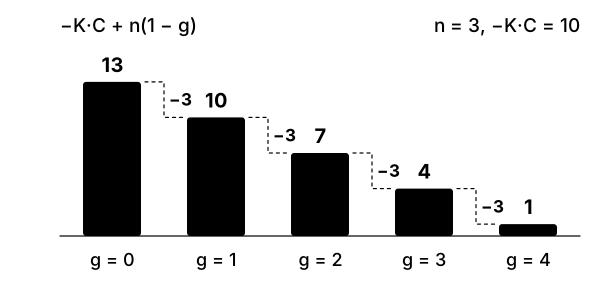
Take a space with n = 3 and a curve with −K·C = 10. With no holes, the curve has at least 10 + 3 = 13 knobs. With one hole it has at least 10, then 7, 4 and finally 1. Each hole takes away 3 knobs, the price of one pin.
Three caveats. This is a guaranteed minimum: the real family can have more knobs, never fewer. It needs the space to be smooth along the curve, with no sharp points there, and the paper assumes this. And it counts every way of drawing the curve, not only its shape, so a line in the plane gets 5, not the 2 of Part 3.
The paper’s theorem assumes −K·C > 0 (it writes K_X·C < 0). Part 8 and Part 9 show why: the paper gets more knobs by making −K·C bigger, and holes get in the way.
References参考資料
In one lineひとことで
曲線の穴は、1 つにつき n 本のつまみを減らします。ピン 1 本と同じです。
第 4 回で、ピンを 1 本打つと、つまみが n 本へることを見ました。n は空間の次元です。論文はピンをたくさん打ちたいので、曲線のつまみが何本あるかを知る必要があります。第 3 回では式の係数を数えましたが、これは式で書ける曲線にしか使えません。論文は、どんな曲線 C にも使える、次の見積もりを使います。
つまみ ≥ −K·C + n(1 − g)
g は C の穴の数です(第 5 回)。−K·C は、第 6 回の大きさと同じように数えます。ただし、空間ごとに決まっている特別なものさし −K を使います。例を 1 つ挙げます。射影空間は、n 次元の空間に無限の遠くの点を足して、平行な直線も交わるようにしたものです(第 15 回)。射影空間では、−K で数えると、平らなものさしの n + 1 倍になります。だから直線なら −K·C = n + 1 です。
この見積もりは、2 つの部分からできています。−K·C は、つまみを増やします。−K·C が大きいほど、曲線は動きやすくなります。n(1 − g) は、穴のない曲線に n 本を足し、穴が 1 つ増えるごとに n 本を引きます。つまり、穴 1 つで、ピン 1 本と同じだけつまみが減ります。
たとえば n = 3 の空間で、−K·C = 10 の曲線を考えます。穴がなければ、つまみは少なくとも 10 + 3 = 13 本です。穴が 1 つなら 10 本、2 つなら 7 本、3 つなら 4 本、4 つなら 1 本です。穴が 1 つ増えるたびに、ピン 1 本ぶんの 3 本が消えます。
注意が 3 つあります。1 つ目に、これは保証された最低の本数です。実際の族は、もっと多くのつまみをもつこともあります。少なくなることはありません。2 つ目に、空間が曲線に沿ってなめらかで、とがった点がないことが必要です。論文もこれを仮定しています。3 つ目に、この式は曲線の形だけでなく、描き方の違いも数えます。だから平面の直線では、第 3 回の 2 本ではなく 5 本になります。
論文の定理は、−K·C > 0 を仮定しています(論文では K_X·C < 0 と書きます)。その理由は、第 8 回と第 9 回で見えてきます。論文は −K·C を大きくして、つまみを増やします。そのとき、穴がじゃまをします。