Every circle is one point in a 3-dimensional space of circles円はみな、3 次元の「円の空間」の 1 点になる
Seriesシリーズ · Part 3 of 173 / 17
All parts ↓すべての回 ↓Bend-and-Shatter, made simpleやさしい Bend-and-Shatter
Goal: ゴール:Learn how one movable curve tells you which simple curves fill a space, and why the best bound is n + 1.動ける曲線 1 本から、空間を編む単純な曲線を言い当てるしくみと、上限が n + 1 になる理由を知る。 Why it’s interesting →なぜ面白いのか →
In one lineひとことで
To count how freely a curve can move, count the numbers that pick it out.
Part 2 counted the numbers needed to say where a point is on a shape. The paper this series follows goes further: it moves whole curves. So it needs to count how freely a curve can move. The same idea works. Count the numbers that pick out one curve.
A circle in the plane is fixed by three numbers: its center (a, b) and its radius r. Its equation is (x − a)² + (y − b)² = r². Choose a, b and r, and you get one circle. And every circle has just one center and one radius. So each circle matches exactly one point (a, b, r) in a 3-dimensional space. Slide a circle or grow it a little, and its point moves a little.
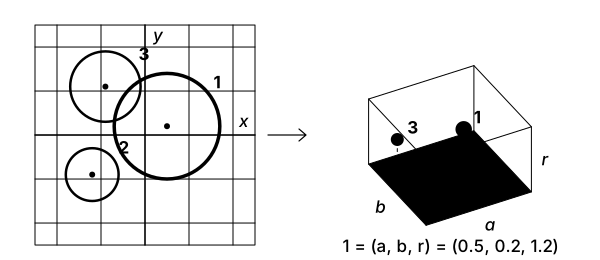
So three different dimensions show up here. The circle itself is 1-dimensional. The plane it sits in is 2-dimensional. And all the circles together form a 3-dimensional space.
A collection of curves that change shape bit by bit like this is called a family. In this series, the numbers that pick out one curve in a family are its knobs. The number of knobs is the family’s dimension. Circles have 3 knobs. Lines have 2, such as the slope m and the intercept c in y = mx + c.
Curves with more complicated equations have more knobs. Take curves whose equation has degree d, meaning its terms multiply x and y together at most d times. Such an equation has (d + 1)(d + 2)/2 coefficients. Multiplying the whole equation by the same number doesn’t change the curve, so one coefficient is spare. That leaves d(d + 3)/2 knobs: 2 for lines, 5 for degree 2, 9 for degree 3. Circles are degree 2 too. They form a 3-dimensional family inside those 5 dimensions.
The paper does the same thing. It takes a family of curves and counts its knobs, which it calls the dimension of the family. Part 4 shows that pinning a curve at one point uses up n of them, where n is the dimension of the space.
References参考資料
In one lineひとことで
曲線がどれだけ自由に動けるかは、その曲線を決める数の個数で数えます。
第 2 回では、図形の上の点の場所を言うのに要る数を数えました。このシリーズで読む論文は、さらに曲線そのものを動かします。そこで、曲線がどれだけ自由に動けるかを数える必要があります。やり方は同じです。曲線 1 本を決めるのに要る数を数えます。
平面の円は、3 つの数で決まります。中心の (a, b) と、半径 r です。式で書くと (x − a)² + (y − b)² = r² です。a、b、r を決めると、円が 1 つ決まります。逆に、どの円にも、中心と半径は 1 つずつしかありません。だから、円 1 つは、3 次元の空間の点 (a, b, r) 1 つと対応します。円を少しずらしたり、少し大きくしたりすると、点も少し動きます。
ここには、3 つの違う「次元」が出てきます。円そのものは 1 次元です。円が置かれている平面は 2 次元です。そして円を全部集めると、3 次元の空間になります。
このように、少しずつ形を変える曲線の集まりを「族」といいます。このシリーズでは、族の中の曲線 1 本を決める数を「つまみ」と呼びます。つまみの本数が、族の次元です。円の族は、つまみが 3 本です。直線なら 2 本です。たとえば y = mx + c の傾き m と切片 c です。
式が複雑な曲線ほど、つまみは多くなります。式の次数が d の曲線で数えてみます。次数は、x と y をあわせて何回までかけた項があるかです。この式には、係数が (d + 1)(d + 2)/2 個あります。でも、式全体を同じ数倍しても、曲線は変わりません。そのぶん 1 つ引いて、つまみは d(d + 3)/2 本です。直線(d = 1)なら 2 本、2 次なら 5 本、3 次なら 9 本です。円も 2 次の曲線です。円は、この 5 次元の中の 3 次元の族です。
論文も、同じように考えます。曲線の族をとって、つまみの本数を数えます。論文の言葉では、族の次元です。第 4 回では、曲線を 1 点で留めると、つまみが n 本へることを見ます。n は空間の次元です。