Lines in projective space show n + 1 can’t be improved射影空間の直線で、n + 1 がこれ以上下げられないと分かる
Seriesシリーズ · Part 15 of 1715 / 17
All parts ↓すべての回 ↓Bend-and-Shatter, made simpleやさしい Bend-and-Shatter
Goal: ゴール:Learn how one movable curve tells you which simple curves fill a space, and why the best bound is n + 1.動ける曲線 1 本から、空間を編む単純な曲線を言い当てるしくみと、上限が n + 1 になる理由を知る。 Why it’s interesting →なぜ面白いのか →
In one lineひとことで
A bound is the best possible when some example meets it exactly.
The theorem’s bound is (n + 1) × size ÷ (−K·C). Part 14 used it to find lines on the tower. Could a number smaller than n + 1 work too? The paper answers with one example: lines in projective space.
Projective space ℙⁿ is n-dimensional space with points at infinity added, so that parallel lines meet. Take a flat ruler in it, a hyperplane. A straight line crosses a hyperplane in general position exactly once, so a line has size 1. In ℙⁿ, −K·C is always n + 1 times the size, so a line L has −K·L = n + 1.
Now start the theorem from a line. The bound is
(n + 1) × 1 ÷ (n + 1) = 1.
The theorem promises a rational curve of size at most 1 through every point of the line. The line itself is one. The bound is met exactly.
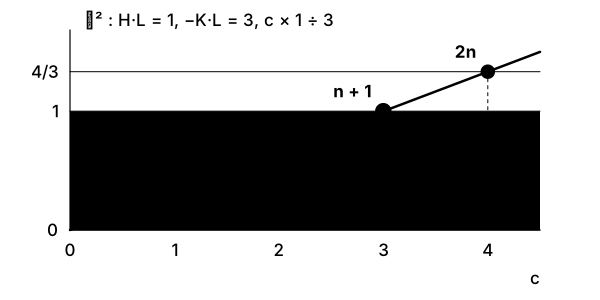
Suppose the constant were some c smaller than n + 1. The bound would be c ÷ (n + 1), which is less than 1. But every curve in ℙⁿ crosses a hyperplane at least once, so no curve has size below 1. The theorem would promise a curve that can’t exist. So no constant below n + 1 works, and n + 1 is the best possible.
Starting from another curve changes nothing. A curve of size e in ℙⁿ has −K·C = (n + 1) × e, so the bound is again exactly 1, and a line is what you find. The paper says all this in one sentence: the improvement is optimal, as X can be ℙⁿ and H a hyperplane.
The old constant 2n gives 2n ÷ (n + 1) instead, 4/3 in the plane. That is still true, but it sits above the size 1 that lines actually have, which left room for the improvement.
References参考資料
In one lineひとことで
ある例がぴったり当てはまる上限は、それ以上良くできません。
定理の上限は、(n + 1) × 大きさ ÷ (−K·C) です。第 14 回では、これを使って塔の直線を見つけました。では、n + 1 より小さい数でも成り立つでしょうか。論文は、1 つの例で答えます。射影空間の直線です。
射影空間 ℙⁿ は、n 次元の空間に無限の遠くの点を足したものです。平行な直線も、そこで交わります。この中で、平らなものさしとして超平面をとります。直線は、ふつうの位置にある超平面とちょうど 1 回交わります。だから直線の大きさは 1 です。ℙⁿ では、−K·C がいつも大きさの n + 1 倍です。だから直線 L は −K·L = n + 1 です。
では、直線から定理を使います。上限はこうなります。
(n + 1) × 1 ÷ (n + 1) = 1
定理は、直線のどの点にも、大きさ 1 以下の有理曲線が通ると言います。直線そのものが、その曲線です。上限にぴったり当たっています。
定数を、n + 1 より小さい c にしてみます。上限は c ÷ (n + 1) で、1 より小さくなります。でも ℙⁿ の曲線は、どれも超平面と 1 回以上交わります。大きさが 1 より小さい曲線はありません。すると定理は、ありえない曲線があると言ってしまいます。だから n + 1 より小さい定数は成り立ちません。n + 1 が最良です。
ほかの曲線から始めても同じです。ℙⁿ で大きさ e の曲線は、−K·C = (n + 1) × e です。上限はまたちょうど 1 で、見つかるのは直線です。論文はこれを 1 文で書いています。改善は最良で、X を ℙⁿ、H を超平面にとればよい、と。
昔の定数 2n だと、上限は 2n ÷ (n + 1) です。平面なら 4/3 です。これも正しいのですが、直線の大きさ 1 より上にあります。そこに、改善の余地が残っていました。