A curved tower can be built from straight rods曲がった塔も、まっすぐな棒だけで組める
Seriesシリーズ · Part 1 of 171 / 17
All parts ↓すべての回 ↓Bend-and-Shatter, made simpleやさしい Bend-and-Shatter
Goal: ゴール:Learn how one movable curve tells you which simple curves fill a space, and why the best bound is n + 1.動ける曲線 1 本から、空間を編む単純な曲線を言い当てるしくみと、上限が n + 1 になる理由を知る。
In one lineひとことで
Whether a straight line fits on a surface depends on its equation, not on how curved it looks.
Kobe Port Tower stands 108 meters tall by the port of Kobe. It was finished in 1963. It’s narrow in the middle, like a Japanese hand drum, and from a distance it looks curved. Up close, it’s made of 32 steel pipes, and each one runs in a straight line, at a slant.
This shape is called a hyperboloid. Through every point on it pass two straight lines that lie entirely on the surface.
Compare other surfaces. A cylinder has straight lines on it too, but only one passes through each point: the vertical one. A sphere has none. A ruler touches it at one point, and both ends lift off. Only curved lines fit on a sphere, and the simplest of them is the circle.
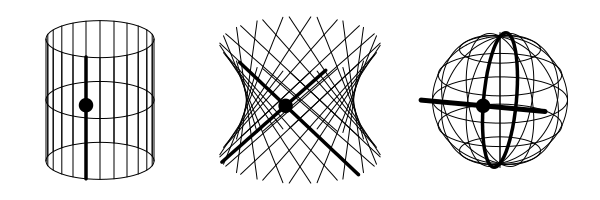
So whether a straight line fits on a surface doesn’t depend on how curved it looks. It depends on the surface’s equation.
Mathematicians ask the same question about spaces with many dimensions, which no one can picture. They look for curves that a single number can trace, like lines and circles. These are called rational curves. When rational curves pass through every point, the space is much easier to study.
In 1979, Shigefumi Mori found a way to find them, called bend-and-break. Take a curve that has room to move. Pin some of its points and keep moving it. It can’t stay in one piece: it bends, then breaks, and a rational curve snaps off. In 1986, Yoichi Miyaoka and Mori used this to show that rational curves pass through every point of such a curve. They also put a bound on how big those curves need to be.
In 2025, Eric Jovinelly, Brian Lehmann and Eric Riedl made that bound as small as it can be. Their key step makes the curve break at every pinned point at once, not at just one. They call it bend-and-shatter. Straight lines meet the new bound exactly, so no one can improve it.
This series follows their paper in 17 short parts, with pictures and small examples. It starts from what “dimension” counts.
References参考資料
In one lineひとことで
まっすぐな線が面に収まるかどうかは、見た目ではなく、面の式で決まります。
神戸ポートタワーは、神戸港にある高さ 108 m のタワーです。1963 年にできました。まん中がくびれた鼓の形で、遠くから見ると曲がって見えます。でも近くで見ると、32 本の鋼管でできています。どの管も、斜めにまっすぐのびています。
この形を、一葉双曲面といいます。面のどの点にも、まっすぐな線が 2 本通っています。どちらの線も、全体が面の上にのっています。
ほかの面と比べてみます。円柱にも、まっすぐな線がのっています。ただし、1 つの点を通るのは縦の 1 本だけです。球面には、まっすぐな線が 1 本ものりません。定規を当てても 1 点でふれるだけで、両はしが面から浮きます。球面にのるのは、曲がった線だけです。その中でいちばん単純なのが、円です。
つまり、まっすぐな線が面に収まるかどうかは、見た目の曲がり方では決まりません。面の式で決まります。
数学では、同じことを次元の高い空間で考えます。目で見ることはできない空間です。そこで探すのは、直線や円のように、1 つの数で描ける曲線です。これを有理曲線といいます。どの点にも有理曲線が通っていれば、その空間はずっと調べやすくなります。
1979 年、森重文さんが、有理曲線を見つける方法を考えました。Bend-and-Break(曲げて折る)と呼ばれる方法です。動ける余地のある曲線をとり、いくつかの点をピンで留めたまま動かし続けます。すると曲線は 1 つのままではいられません。曲がって、やがて折れます。そして、有理曲線がちぎれ出ます。1986 年には宮岡洋一さんと森さんが、この方法で、その曲線のどの点にも有理曲線が通ることを示しました。その有理曲線の大きさにも、上限をつけました。
2025 年、Jovinelly さん、Lehmann さん、Riedl さんの 3 人が、この上限をこれ以上良くできないところまで下げました。かぎは、ピンで留めたすべての点で、曲線を同時に折ることです。3 人はこれを Bend-and-Shatter(曲げて粉々にする)と呼んでいます。直線がこの新しい上限にぴったり当てはまるので、もう下げられません。
このシリーズでは、この論文を 17 回に分けて、図と小さな例でたどります。最初は、「次元」が何を数えているかから始めます。