A shape’s dimension is how many numbers its address needs次元は、場所を言うのに要る数の個数
Seriesシリーズ · Part 2 of 172 / 17
All parts ↓すべての回 ↓Bend-and-Shatter, made simpleやさしい Bend-and-Shatter
Goal: ゴール:Learn how one movable curve tells you which simple curves fill a space, and why the best bound is n + 1.動ける曲線 1 本から、空間を編む単純な曲線を言い当てるしくみと、上限が n + 1 になる理由を知る。 Why it’s interesting →なぜ面白いのか →
In one lineひとことで
Count a shape’s dimension by the numbers a point’s address needs, not by the directions you can see.
The paper this series follows uses the word “dimension” all the time. Its space X has n dimensions, and a family of moving curves can have many more. No one can picture that many directions, so the paper counts something else.
A shape’s dimension is how many numbers you need to say where a point is on it. A curve drawn on paper needs one: how far along the curve you are. So the curve is 1-dimensional, even though the paper is 2-dimensional. The bowl z = x² + y² sits in 3-dimensional space. But once you choose x and y, z is fixed. Its address needs two numbers, so the bowl is 2-dimensional.
You can also count from outside. Start with the whole space and add equations. Each equation lowers the dimension by at most one.
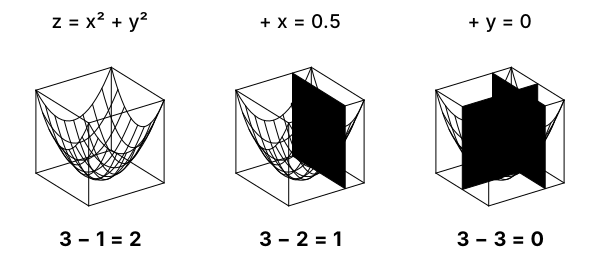
In 3-dimensional space, z = x² + y² leaves the bowl: 3 − 1 = 2. Adding x = 0.5 leaves a curve on the bowl: 3 − 2 = 1. Adding y = 0 leaves one point, (0.5, 0, 0.25): 3 − 3 = 0. So naming one point in 3-dimensional space takes three equations. In n-dimensional space it takes n. Part 4 uses this to show what pinning a curve at a point costs.
“At most” matters. z = x² + y² and 2z = 2x² + 2y² are two equations, but the second only doubles the first. The bowl stays 2-dimensional. So equations give a lower bound: a shape has at least (the space’s dimension − the number of equations) dimensions. That’s why the paper says a family of curves has “at least” so many dimensions.
This bound needs complex numbers. Over the real numbers, x² + y² + z² = 0 has one solution, (0, 0, 0). One equation took away all three dimensions. Over the complex numbers, where i² = −1, (1, i, 0) is a solution too, and all the solutions together form a 2-dimensional shape, as the bound says. The paper works with complex numbers and number systems like them. There, the bound always holds as long as some points are left.
References参考資料
In one lineひとことで
次元は、見える向きの数ではなく、点の場所を言うのに要る数の個数で数えます。
このシリーズで読む論文には、「次元」という言葉が何度も出てきます。空間 X は n 次元です。動く曲線の集まりは、もっと大きな次元になることもあります。そんなにたくさんの向きは、目では見えません。そこで論文は、別のものを数えています。
図形の次元は、図形の上の点の場所を言うのに要る数の個数です。紙に描いた曲線なら、数は 1 つで足ります。曲線に沿って、どれだけ進んだかです。だから曲線は 1 次元です。紙は 2 次元でも、曲線は 1 次元です。お椀の形の面 z = x² + y² は、3 次元の空間にあります。でも x と y を決めると、z も決まります。場所を言うのに要る数は 2 つなので、このお椀は 2 次元です。
外から数えることもできます。空間全体から始めて、式を 1 本ずつ足していきます。式を 1 本足すごとに、次元は多くても 1 つ下がります。
3 次元の空間で、z = x² + y² を満たす点だけを残すと、お椀になります。3 − 1 = 2 です。x = 0.5 を足すと、お椀の上の曲線が残ります。3 − 2 = 1 です。y = 0 も足すと、点 (0.5, 0, 0.25) が 1 つだけ残ります。3 − 3 = 0 です。つまり、3 次元の空間で 1 点を言い当てるには、式が 3 本要ります。n 次元なら n 本です。第 4 回では、これを使って、曲線を 1 点で留めると何が減るかを見ます。
「多くても」が大事です。z = x² + y² と 2z = 2x² + 2y² は 2 本の式です。でも 2 本目は、1 本目を 2 倍しただけです。お椀は 2 次元のままです。だから、式の本数からわかるのは下限です。図形の次元は、少なくとも「空間の次元 − 式の本数」です。論文が曲線の集まりの次元を「少なくとも」と書くのは、このためです。
ただし、この下限は複素数で考えたときの話です。実数では、x² + y² + z² = 0 を満たす点は (0, 0, 0) だけです。式 1 本で、3 つの次元が全部なくなりました。複素数には、i² = −1 となる数 i があります。すると (1, i, 0) も式を満たします。満たす点を全部集めると 2 次元の図形になり、下限のとおりです。論文は、複素数や、それに似た数で考えています。そこでは、点が 1 つでも残っていれば、この下限が必ず成り立ちます。