Squashing directions now have length at most n + 1, not 2n押しつぶす向きの長さは、2n ではなく n + 1 以下
Seriesシリーズ · Part 16 of 1716 / 17
All parts ↓すべての回 ↓Bend-and-Shatter, made simpleやさしい Bend-and-Shatter
Goal: ゴール:Learn how one movable curve tells you which simple curves fill a space, and why the best bound is n + 1.動ける曲線 1 本から、空間を編む単純な曲線を言い当てるしくみと、上限が n + 1 になる理由を知る。 Why it’s interesting →なぜ面白いのか →
In one lineひとことで
Wherever a proof used Miyaoka and Mori’s constant 2n, the new theorem can put n + 1 instead.
What is the new bound good for? One answer is the minimal model program, a theory that simplifies a space step by step. Each step squashes a whole family of curves down to points.
Curves on a space can be sorted by direction, and each step squashes all the curves that point one way. On the tower, every curve counts as so many lines from one family plus so many from the other. In Part 10, a circle snapped into one line of each. The two families are the tower’s two squashing directions. Squash every line of one family to a point, and the tower becomes a single curve. Mathematicians call a squashing direction an extremal ray.
Each squashing direction has a length: the smallest −K·C among the rational curves pointing that way. On the tower, both lengths are 2. In the projective plane, the only direction is that of lines, and its length is 3.
In 1982, Mori showed that on a space with no sharp points, every squashing direction has length at most n + 1. But the theory also needs spaces with mildly sharp points, like the tip of a cone. For those, the best bound was 2n, in work from Kawamata in 1991 to Fujino in 2011. Those proofs used Miyaoka and Mori’s 1986 theorem, which carries the constant 2n. The paper puts its own theorem in that place and gets n + 1. This is its Theorem 1.3.
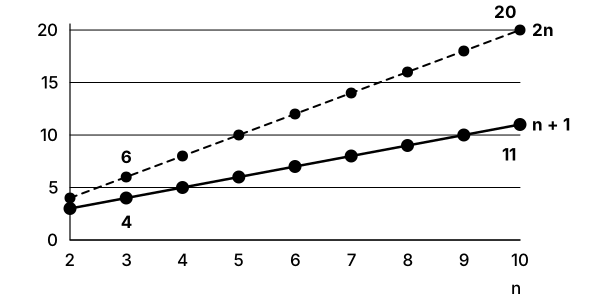
For a 3-dimensional space, 6 becomes 4. For a 10-dimensional one, 20 becomes 11. And lines in projective space have length exactly n + 1 (Part 15), so this bound can’t be lowered either.
The paper states it for spaces whose sharp points stay within a range called log canonical, and for number systems of characteristic 0, such as the complex numbers.
References参考資料
- Jovinelly, Lehmann, Riedl: Optimal bounds in Bend-and-Break (arXiv:2509.08065)
- Mori: Threefolds whose canonical bundles are not numerically effective (Annals of Mathematics, 1982)
- Kawamata: On the length of an extremal rational curve (Inventiones Mathematicae, 1991)
- Fujino: Fundamental theorems for the log minimal model program (Publications of RIMS, 2011)
- Miyaoka, Mori: A numerical criterion for uniruledness (Annals of Mathematics, 1986)
In one lineひとことで
宮岡・森の定数 2n を使っていた証明は、新しい定理で n + 1 にできます。
新しい上限は、何に役立つのでしょう。答えの 1 つが、極小モデル理論です。空間を一歩ずつ簡単にしていく理論です。一歩ごとに、曲線の族をまるごと押しつぶして、点にします。
空間の曲線は、向きで分けられます。理論の一歩では、同じ向きの曲線をまとめて押しつぶします。塔なら、どの曲線も「片方の組の直線何本ぶん」と「もう片方の組の直線何本ぶん」で表せます。第 10 回では、輪が両方の組から 1 本ずつの直線に折れました。この 2 つの組が、塔の 2 つの押しつぶす向きです。片方の組の直線をみな点に押しつぶすと、塔は曲線 1 本になります。押しつぶす向きは、極値射線とも呼ばれます。
押しつぶす向きには、長さがあります。その向きの有理曲線のうち、いちばん小さい −K·C です。塔では、2 つの向きの長さはどちらも 2 です。射影平面では、向きは直線の向き 1 つだけで、長さは 3 です。
1982 年、森さんは、とがった点のない空間では、どの押しつぶす向きも長さが n + 1 以下だと示しました。でもこの理論では、円すいの頂点のような、少しとがった点のある空間も扱います。そこでの上限は、川又さんの 1991 年の論文から藤野さんの 2011 年の論文まで、2n でした。これらの証明は、宮岡さんと森さんの 1986 年の定理を使っていて、その定数が 2n です。論文は、そこに自分たちの定理を入れて、n + 1 にしました。論文の定理 1.3 です。
3 次元なら、6 が 4 になります。10 次元なら、20 が 11 になります。そして射影空間の直線の向きは、長さがちょうど n + 1 です(第 15 回)。だから、この上限もこれ以上は下げられません。
論文では、とがり方が「対数的標準(lc)」とよばれる範囲の空間を扱います。数は、複素数のような標数 0 の数です。
References参考資料
- Jovinelly, Lehmann, Riedl:Optimal bounds in Bend-and-Break(arXiv:2509.08065)
- 森重文:Threefolds whose canonical bundles are not numerically effective(Annals of Mathematics、1982 年)
- 川又雄二郎:On the length of an extremal rational curve(Inventiones Mathematicae、1991 年)
- 藤野修:Fundamental theorems for the log minimal model program(Publications of RIMS、2011 年)
- 宮岡洋一、森重文:A numerical criterion for uniruledness(Annals of Mathematics、1986 年)