One circle’s numbers prove the tower is made of lines輪 1 本の数字から、塔が棒で編まれていると分かる
Seriesシリーズ · Part 14 of 1714 / 17
All parts ↓すべての回 ↓Bend-and-Shatter, made simpleやさしい Bend-and-Shatter
Goal: ゴール:Learn how one movable curve tells you which simple curves fill a space, and why the best bound is n + 1.動ける曲線 1 本から、空間を編む単純な曲線を言い当てるしくみと、上限が n + 1 になる理由を知る。 Why it’s interesting →なぜ面白いのか →
In one lineひとことで
Once the bound drops below 2, the only curve that fits is one of size 1, a straight line.
Part 1 started with Kobe Port Tower. Its surface is a hyperboloid, and straight lines pass through every point of it. The paper’s theorem can prove this from the numbers of one circle, without looking at the tower.
Take a horizontal circle on the tower. The surface has n = 2 dimensions. The circle has size 2, because a flat ruler crosses it twice. On this surface −K·C is twice the size, so −K·C = 4. The circle has no holes. The theorem says that through every point of the circle passes a rational curve R whose size is at most
(n + 1) × size ÷ (−K·C) = 3 × 2 ÷ 4 = 1.5.
Sizes are whole numbers, so R has size 1. A curve that a flat ruler crosses only once is a straight line. Every point of the tower lies on some horizontal circle, and they all have the same numbers. So a line passes through every point.
Where does 1.5 come from? The proof wraps the circle many times, which multiplies its size and its knobs (Part 9). It spends n + 1 knobs on each pin (Part 13), and the curve breaks off one piece at each pin. The pieces and the rest of the curve share the total size, and none of them is negative. So the smallest piece is at most the total divided by the number of pins. Here is the count with p = 2.
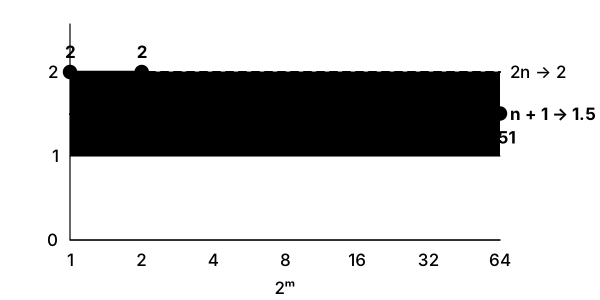
Wrapped 4 times, the circle has at least 16 knobs by the paper’s estimate, which leaves out the + n (Part 9). That is enough for 5 pins, and the total size is 8. The average is 8 ÷ 5 = 1.6. Wrapped 64 times, it has 256 knobs, 85 pins and total size 128, an average of about 1.51. The more it wraps, the closer the average gets to 1.5.
The old constant 2n gives 2 × 2 × 2 ÷ 4 = 2 instead. Size 2 still allows the circle itself, so the old bound can’t tell whether lines exist. The step from 2n down to n + 1 is what settles it.
References参考資料
In one lineひとことで
上限が 2 を下回れば、当てはまるのは大きさ 1 の曲線、つまり直線だけです。
第 1 回は、神戸ポートタワーから始めました。塔の面は一葉双曲面で、どの点にもまっすぐな線が通っています。論文の定理を使うと、このことを輪 1 本の数字だけから示せます。塔を見る必要はありません。
塔の水平な輪を 1 本とります。面の次元は n = 2 です。輪の大きさは 2 です。平らなものさしと 2 回交わるからです。この面では −K·C が大きさの 2 倍なので、−K·C = 4 です。輪に穴はありません。定理によると、輪のどの点にも、大きさが次の値以下の有理曲線 R が通ります。
(n + 1) × 大きさ ÷ (−K·C) = 3 × 2 ÷ 4 = 1.5
大きさは整数なので、R の大きさは 1 です。平らなものさしと 1 回しか交わらない曲線は、直線です。塔のどの点も、どれかの水平な輪の上にあります。どの輪も、数字は同じです。だから、塔のどの点にも直線が通ります。
1.5 はどこから来るのでしょう。証明では、輪を何重にも巻きつけます。すると大きさも、つまみも増えます(第 9 回)。ピン 1 本につまみを n + 1 本ずつ使い(第 13 回)、曲線はピンごとにかけらを 1 つ出して折れます。かけらと残りの部分で、大きさの合計を分け合います。どれもマイナスにはなりません。だから、いちばん小さいかけらは、合計をピンの本数で割った値以下です。p = 2 で数えると、こうなります。
4 重に巻くと、論文の見積もりで、つまみは少なくとも 16 本です。この見積もりは + n を省いています(第 9 回)。ピンは 5 本打てます。大きさの合計は 8 なので、平均は 8 ÷ 5 = 1.6 です。64 重に巻くと、つまみ 256 本、ピン 85 本、合計 128 で、平均は約 1.51 です。巻くほど、平均は 1.5 に近づきます。
昔の定数 2n だと、上限は 2 × 2 × 2 ÷ 4 = 2 です。大きさ 2 なら、輪そのものも当てはまります。これでは、直線があるかどうか決められません。2n が n + 1 に下がったことで、はじめて答えが出ます。