Each pin costs n + 1 knobs, and that is where n + 1 comes fromピン 1 本につまみ n + 1 本。これが n + 1 の正体
Seriesシリーズ · Part 13 of 1713 / 17
All parts ↓すべての回 ↓Bend-and-Shatter, made simpleやさしい Bend-and-Shatter
Goal: ゴール:Learn how one movable curve tells you which simple curves fill a space, and why the best bound is n + 1.動ける曲線 1 本から、空間を編む単純な曲線を言い当てるしくみと、上限が n + 1 になる理由を知る。 Why it’s interesting →なぜ面白いのか →
In one lineひとことで
Divide a family’s knobs by n + 1 to get how many pins it can afford. That is the n + 1 in the theorem.
The bound in the 2025 paper (Part 1) has n + 1 in it, where n is the dimension of the space. It is the price of one pin.
A pin has two jobs. First, it holds a point of the curve at a fixed place in the space. That costs n knobs, one for each coordinate (Part 4). Second, the curve must break at that pin. In Part 12, that took a mark kept on a wall, and keeping the mark there uses one more knob. So each pin costs n + 1 knobs.
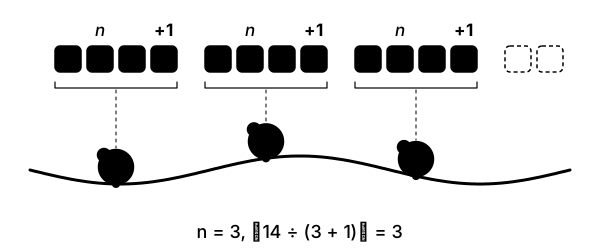
Now count. If a family of curves has d knobs (the paper writes dim M), you can afford k = ⌊d ÷ (n + 1)⌋ pins. This is Proposition 2.2. It also assumes 2g − 2 + k > 0, where g is the number of holes. That makes sure no knob is wasted on just moving the curve along itself. For a curve with no holes, it means at least three pins.
With k pins, the curve breaks into k rational pieces, one at each pin. Their sizes add up to at most the size of the curve, because the ruler H never gives a negative size (H is nef). So some piece has size at most the curve’s size divided by k. For example, in a space of dimension 3, a family with 100 knobs affords ⌊100 ÷ 4⌋ = 25 pins. If the curve has size 500, some piece has size at most 500 ÷ 25 = 20.
More knobs per unit of size means smaller pieces. Part 7 shows the knobs grow with −K·C. Wrap the curve many times (Part 8, Part 9), and the bound on the smallest piece approaches (n + 1) · H·C ÷ (−K·C), the bound in the theorem. Part 14 runs the numbers.
Miyaoka and Mori’s 1986 bound had 2n where this has n + 1. Their proof used a family of one dimension with a fixed point, which breaks off one rational curve. Paying n + 1 per pin and breaking at all k pins at once is the new step.
References参考資料
In one lineひとことで
族のつまみの本数を n + 1 で割ると、打てるピンの本数が分かります。これが定理の n + 1 です。
2025 年の論文(第 1 回)の上限には、n + 1 が出てきます。n は空間の次元です。この n + 1 は、ピン 1 本の値段です。
ピンには、仕事が 2 つあります。1 つ目は、曲線の点を、空間の決まった場所に留めることです。これには、座標 1 つにつき 1 本、合わせて n 本のつまみを使います(第 4 回)。2 つ目は、そのピンのところで曲線を折ることです。第 12 回では、そのために印を壁に乗せておきました。印を壁に乗せておくのに、つまみをもう 1 本使います。だから、ピン 1 本でつまみ n + 1 本です。
では数えます。曲線の族のつまみが d 本なら(論文では dim M)、打てるピンは k = ⌊d ÷ (n + 1)⌋ 本です。これが命題 2.2 です。命題 2.2 は、2g − 2 + k > 0 も仮定しています。g は穴の数です。この仮定で、曲線を自分自身に沿って滑らせるだけのむだなつまみが残らなくなります。穴のない曲線なら、ピンが 3 本以上要るということです。
ピンが k 本なら、曲線は k 個の有理曲線のかけらに折れます。ピン 1 本につき 1 個です。かけらの大きさを足しても、もとの曲線の大きさを超えません。ものさし H で測った大きさは、負にならないからです(H はネフ)。だから、どれかのかけらの大きさは、曲線の大きさ ÷ k 以下です。たとえば 3 次元の空間で、つまみが 100 本の族なら、ピンは ⌊100 ÷ 4⌋ = 25 本打てます。曲線の大きさが 500 なら、どれかのかけらの大きさは 500 ÷ 25 = 20 以下です。
大きさにくらべてつまみが多いほど、かけらは小さくなります。第 7 回で見たとおり、つまみは −K·C とともに増えます。曲線を何重にも巻きつけると(第 8 回、第 9 回)、いちばん小さいかけらの上限は (n + 1) · H·C ÷ (−K·C) に近づきます。これが定理の上限です。数字で追うのは第 14 回です。
宮岡さんと森さんの 1986 年の上限では、n + 1 のところが 2n でした。2 人の証明は、1 点を留めた 1 次元の族を使い、有理曲線を 1 本折り出すものでした。ピン 1 本に n + 1 本を払い、k 本のピンすべてで同時に折る。これが、新しい一歩です。