Pin a circle at two points and tilt it: it snaps into two lines2 点で留めた輪を傾けると、2 本の棒に折れる
Seriesシリーズ · Part 10 of 1710 / 17
All parts ↓すべての回 ↓Bend-and-Shatter, made simpleやさしい Bend-and-Shatter
Goal: ゴール:Learn how one movable curve tells you which simple curves fill a space, and why the best bound is n + 1.動ける曲線 1 本から、空間を編む単純な曲線を言い当てるしくみと、上限が n + 1 になる理由を知る。 Why it’s interesting →なぜ面白いのか →
In one lineひとことで
Pin a curve before you move it. With no way to slide, it has to break.
The tower in Part 1 is a hyperboloid. Take it as x² + y² − z² = 1. It is woven from straight lines. Here is a way to find one of them by moving a curve.
A circle runs around the tower’s waist, at height z = 0. Pin it at two points, (0, 1, 0) and (0, −1, 0). Now cut the tower with a flat plate that always contains the line through both pins, and tilt the plate by an angle θ. The cut always passes through both pins. So tilting the plate moves the curve while it stays pinned. The tilt is the one knob.
Measure along the plate with u, so a point on it is (u cos θ, y, u sin θ). Put that into the tower’s equation, and the cut is cos 2θ · u² + y² = 1.
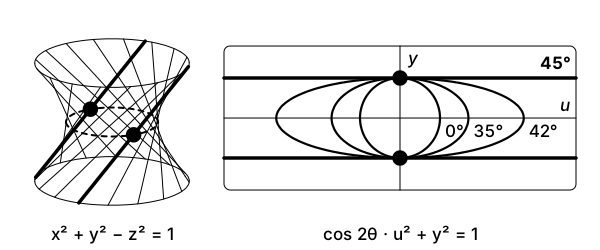
At θ = 0 this is the circle u² + y² = 1. As θ grows, the coefficient of u² shrinks, and the curve becomes an ever wider ellipse. Its half-width grows from 1 at 0° to 1.71 at 35°, 3.09 at 42° and 5.35 at 44°. At 45° the coefficient reaches 0, and the equation becomes y² = 1. The curve has snapped into two straight lines, (x, 1, x) and (x, −1, x). Both lie on the tower, since x² + 1 − x² = 1, and each passes through one pin.
The size from Part 6 adds up. The circle crosses a flat plane twice, so its size is 2. Each line crosses it once, and 1 + 1 = 2. The two lines are parallel, so the curve looks as if it fell apart. But once points at infinity are added, parallel lines meet there. So the broken curve is still in one piece.
The pins are what force the break. Without pins, a line on the tower can slide all the way around it and never break. Pinned at two points, the circle can’t slide away, so moving it made it break. Part 11 shows when this is guaranteed, and what the pieces look like.
References参考資料
In one lineひとことで
曲線を動かす前に、ピンで留めます。滑って逃げられない曲線は、折れるしかありません。
第 1 回の塔は、一葉双曲面です。式は x² + y² − z² = 1 とします。この塔は、まっすぐな直線で編まれています。今回は、曲線を動かして、その直線を 1 本見つけます。
塔のくびれ(高さ z = 0)に、輪が 1 本あります。輪の上の 2 点 (0, 1, 0) と (0, −1, 0) を、ピンで留めます。次に、平らな板で塔を切ります。板はいつも、2 本のピンを結ぶ直線を含むようにして、角度 θ だけ傾けます。切り口は、いつも 2 本のピンを通ります。だから板を傾けると、ピンで留めたまま輪が動きます。板の傾きが、ただ 1 本のつまみです。
板の上の位置を u で測ると、板の点は (u cos θ, y, u sin θ) です。これを塔の式に入れると、切り口は cos 2θ · u² + y² = 1 になります。
θ = 0 のとき、切り口は円 u² + y² = 1 です。θ を大きくすると、u² の係数が小さくなり、切り口は横に伸びた楕円になります。横の半径は、0° で 1、35° で 1.71、42° で 3.09、44° で 5.35 です。45° で係数はちょうど 0 になり、式は y² = 1 になります。輪は、2 本の直線 (x, 1, x) と (x, −1, x) に折れました。x² + 1 − x² = 1 なので、どちらも塔の上にあります。そして、それぞれがピンを 1 本ずつ通っています。
第 6 回の大きさも、ちゃんと合います。輪は平らな面と 2 回交わるので、大きさは 2 です。直線は 1 本につき 1 回なので、1 + 1 = 2 です。2 本の直線は平行なので、ばらばらになったように見えます。でも無限の遠くの点を足すと、平行な直線はそこで交わります。だから、折れたあとも、曲線は 1 つにつながっています。
折れたのは、ピンがあるからです。ピンがなければ、塔の上の直線は、塔のまわりをぐるりと滑っても折れません。2 点で留めた輪は、滑って逃げられません。だから、動かすと折れました。どんなときに必ず折れるのか、折れたかけらはどんな形か。それは第 11 回で見ます。