A direction longer than n means the space is projective space向きの長さが n を超えれば、空間は射影空間
Seriesシリーズ · Part 17 of 1717 / 17
All parts ↓すべての回 ↓Bend-and-Shatter, made simpleやさしい Bend-and-Shatter
Goal: ゴール:Learn how one movable curve tells you which simple curves fill a space, and why the best bound is n + 1.動ける曲線 1 本から、空間を編む単純な曲線を言い当てるしくみと、上限が n + 1 になる理由を知る。 Why it’s interesting →なぜ面白いのか →
In one lineひとことで
No length can pass n + 1, and only projective space gets above n.
Part 16 showed that every squashing direction has length at most n + 1. Projective space reaches that top: lines in ℙⁿ have length n + 1. In 2026, Fujino, Jovinelly, Lehmann and Riedl proved that no other space even gets above n. Take an n-dimensional space X over the complex numbers, whose sharp points are no worse than log canonical. If even one squashing direction of X has length more than n, then X is projective space ℙⁿ.
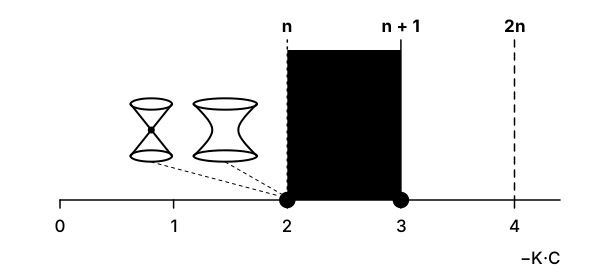
The first step of their proof shows where n + 1 matters. Squash X along that direction, and suppose the result is not a single point. Then the pieces that get squashed to points are smaller than X, with dimension at most n − 1. The new bound, used inside such a piece F, gives a rational curve pointing that way with −K·C at most dim F + 1. That is at most n, which contradicts “longer than n”. So the whole space squashes to one point. The rest of the proof uses other tools, including a test for projective space by Cho, Miyaoka and Shepherd-Barron.
With the old constant, the same step gives −K·C at most 2 × dim F. Take n = 3 and dim F = 2. The old bound is 4, and a curve with −K·C between 3 and 4 fits both the bound and “longer than 3”. There is no contradiction, and the step stalls. The new bound is lower by only 1, but that 1 lands exactly on the line at n.
“Longer than n” can’t be loosened to “at least n”. The tower’s two directions have length exactly 2 = n. So does the direction of the cone from Part 16, the surface with a sharp tip. Yet neither is the projective plane.
This is the last part of the series. It began with a tower built from straight rods and ends with a way to recognize projective space from the length of one direction. Both come from the same bound, n + 1.
References参考資料
In one lineひとことで
長さは n + 1 を超えられず、n を超えられるのは射影空間だけです。
第 16 回では、どの押しつぶす向きも、長さが n + 1 以下だと見ました。射影空間は、その上限に届きます。ℙⁿ の直線は、長さが n + 1 だからです。2026 年、藤野さん、Jovinelly さん、Lehmann さん、Riedl さんは、ほかの空間は n を超えることさえないと示しました。複素数で考えた n 次元の空間 X があり、とがった点は対数的標準(lc)の範囲だとします。X の押しつぶす向きが 1 つでも n より長ければ、X は射影空間 ℙⁿ です。
証明の最初の一歩を見ると、n + 1 がどこで効くかが分かります。X を、その向きに押しつぶします。結果が 1 点ではないとしてみます。すると、点に押しつぶされる部分は X より小さく、次元は n − 1 以下です。そのような部分 F の中で新しい上限を使うと、その向きの有理曲線で、−K·C が dim F + 1 以下のものがあります。これは n 以下です。「n より長い」と食い違います。だから、空間全体が 1 点に押しつぶされます。残りの証明では、Cho さん、宮岡さん、Shepherd-Barron さんによる射影空間の見分け方など、ほかの道具も使います。
昔の定数だと、同じ一歩でわかるのは、−K·C が 2 × dim F 以下ということだけです。n = 3、dim F = 2 としてみます。昔の上限は 4 です。−K·C が 3 と 4 のあいだの曲線なら、上限にも「3 より長い」にも合います。食い違いが出ないので、ここで止まります。新しい上限は 1 低いだけです。でもその 1 が、ちょうど n の線をまたぎます。
「n より長い」を「n 以上」にゆるめることはできません。塔の 2 つの向きは、長さがちょうど 2 = n です。第 16 回に出てきた、頂点がとがった円すいも、向きの長さは 2 です。でも、どちらも射影平面ではありません。
これでシリーズは終わりです。まっすぐな棒で組んだ塔から始めて、向き 1 つの長さで射影空間を見分ける話まで来ました。どちらも、同じ上限 n + 1 から出てきます。