A curve’s size is how often a flat ruler crosses it曲線の大きさは、長さではなく交わる回数
Seriesシリーズ · Part 6 of 176 / 17
All parts ↓すべての回 ↓Bend-and-Shatter, made simpleやさしい Bend-and-Shatter
Goal: ゴール:Learn how one movable curve tells you which simple curves fill a space, and why the best bound is n + 1.動ける曲線 1 本から、空間を編む単純な曲線を言い当てるしくみと、上限が n + 1 になる理由を知る。 Why it’s interesting →なぜ面白いのか →
In one lineひとことで
Measure a curve by its crossings with a flat ruler, and count the hidden ones too.
The bound in Part 1 is about how big a rational curve has to be. But big can’t mean long. A line is infinitely long, and a circle of radius 100 is 100 times longer than one of radius 1. The paper measures size another way.
Lay a straight line, the ruler, across a curve in the plane and count the crossings. A line crosses the ruler once. A circle crosses it twice, whatever its radius. That count is the curve’s size: 1 for a line, 2 for every circle.
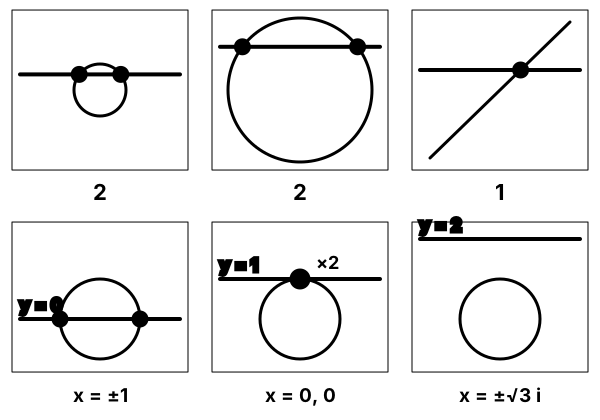
The count must not depend on where the ruler lies, so hidden crossings count too. Put y = c into x² + y² = 1, and you get x² = 1 − c². At c = 0, x = ±1: two crossings you can see. At c = 1, x = 0 twice: the ruler touches the circle, and a touching point counts twice. At c = 2, x = ±√3 i: two complex crossings (Part 5). Points at infinity count as well. A vertical ruler meets the parabola y = x² once where you can see it, and once at infinity.
Counted this way, a plane curve whose equation has degree d always has size d. Putting the ruler into the equation leaves an equation of degree d in one unknown, and that has exactly d answers.
In space, a line usually misses a curve, so the ruler becomes a flat plate. The curve (t, t², t³) meets the plate z = x where t³ = t, at t = 0, 1 and −1. Its size is 3.
The paper writes the size of a curve C as H·C, where H is the ruler. Its rulers are more general than plates. It only asks that H never gives a negative count (it calls such H nef). H may also carry real-number weights, so H·C is a number ≥ 0 but not always a whole number.
Size suits the paper because it doesn’t change as a curve moves in its family. And when a curve breaks, the sizes of the pieces add up to the old size.
References参考資料
In one lineひとことで
曲線は、平らなものさしと交わる回数で測ります。見えない交点も数えます。
第 1 回の上限は、有理曲線がどれだけ大きいかの話です。でも、大きさは長さではありません。直線は無限に長いし、半径 100 の円は、半径 1 の円の 100 倍の長さです。論文は、別の方法で大きさを測ります。
平面の曲線に、まっすぐな線を 1 本当てます。これを、ものさしと呼びます。そして、交わる点を数えます。直線なら、ものさしと 1 回交わります。円なら、半径がいくつでも 2 回です。この回数が、曲線の大きさです。直線は 1、円はどれも 2 です。
ものさしをどこに置いても同じ回数になるように、見えない交点も数えます。x² + y² = 1 に y = c を入れると、x² = 1 − c² です。c = 0 なら x = ±1 で、見える交点が 2 つです。c = 1 なら x = 0 が 2 回です。ものさしは円に接していて、接する点は 2 回と数えます。c = 2 なら x = ±√3 i で、複素数の交点が 2 つです(第 5 回)。無限の遠くの点も数えます。放物線 y = x² に縦のものさしを当てると、見える交点は 1 つで、もう 1 つは無限の遠くにあります。
こう数えると、式の次数が d の平面の曲線は、大きさがいつも d です。ものさしの式を曲線の式に入れると、文字 1 つの d 次方程式になります。その答えは、ちょうど d 個あるからです。
空間では、まっすぐな線はたいてい曲線と交わりません。そこで、平らな板をものさしにします。曲線 (t, t², t³) と板 z = x は、t³ = t のところ、つまり t = 0、1、−1 で交わります。大きさは 3 です。
論文は、曲線 C の大きさを H·C と書きます。H がものさしです。論文のものさしは、板よりも広いものを含みます。条件は、どの曲線を測っても回数が負にならないことです。論文はこれをネフと呼びます。また H には、実数の重みを付けてもかまいません。だから H·C は 0 以上の数ですが、整数とは限りません。
大きさが論文に合うのは、族の中で曲線を動かしても変わらないからです。そして曲線が折れると、かけらの大きさを足したものが、もとの大きさになります。