When a pinned curve breaks, the piece that falls off is a sphere留めた曲線が折れると、ちぎれるかけらは球
Seriesシリーズ · Part 11 of 1711 / 17
All parts ↓すべての回 ↓Bend-and-Shatter, made simpleやさしい Bend-and-Shatter
Goal: ゴール:Learn how one movable curve tells you which simple curves fill a space, and why the best bound is n + 1.動ける曲線 1 本から、空間を編む単純な曲線を言い当てるしくみと、上限が n + 1 になる理由を知る。 Why it’s interesting →なぜ面白いのか →
In one lineひとことで
To find a rational curve, pin a curve and keep moving it until it breaks. What comes off is rational.
In Part 10, a circle on the tower, pinned at two points, broke into two straight lines. That came from one equation. In 1979, Shigefumi Mori showed that curves break like this in any space of this kind, and found what the pieces are. It is called bend-and-break.
Here is the rule, with its conditions. The space X is projective, over the complex numbers or another number system where every polynomial equation has a solution. Take a curve C in X and pin one of its points. Then move C with at least one knob, so that the curve really changes, not just the addresses of its points. If C has holes, one pin is enough. If C has none, it needs two pins, like the circle in Part 10. Then somewhere along the way, the curve breaks.
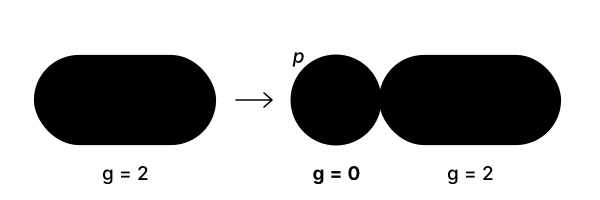
The holes stay with the old curve. Every piece that grows out of it has no holes. It is a rational curve, which over the complex numbers is a sphere (Part 5). One of the pieces passes through the pin. And the sizes add up: the old curve’s size is the sum of the sizes of what it broke into (Part 6).
Why a sphere? Let the knob be a number s. As s changes, every point of C moves, and together they sweep out a surface, with one direction along the curve and one along the knob. At the pin, the motion goes wrong. At the moment of the break, points next to the pin are pulled far apart, so the surface can’t say where that one point goes. The fix is to replace the point with all the directions you can approach it from. The directions through a point of a surface form a projective line, which over the complex numbers is a sphere. That sphere is the piece that comes off. Sometimes the fix takes a few rounds and gives a chain of spheres, but each one is still a sphere.
That is why bend-and-break finds rational curves: break a curve, and what falls off is rational. It can’t choose which pin the piece grows at. Part 12 shows how the 2025 paper makes a piece grow at the pin it wants.
References参考資料
In one lineひとことで
有理曲線を探すなら、曲線をピンで留めて、折れるまで動かします。ちぎれたかけらは有理曲線です。
第 10 回では、塔の上の輪を 2 点で留めて動かすと、2 本の直線に折れました。これは 1 本の式から分かったことです。1979 年、森重文さんは、この種類の空間ならどこでも同じように曲線が折れることを示しました。折れたかけらが何なのかも分かりました。これが Bend-and-Break(曲げて折る)です。
条件もあわせて、きまりを書きます。空間 X は射影空間の中にある図形で、数は複素数か、どんな多項式の方程式にも解がある数です。X の中の曲線 C をとり、その 1 点をピンで留めます。そして、つまみを少なくとも 1 本使って C を動かします。ただし、点の住所を付け替えるだけではなく、曲線が本当に変わる動かし方です。C に穴があれば、ピンは 1 本で足ります。穴がなければ、第 10 回の輪のように、ピンが 2 本要ります。すると、動かす途中のどこかで、曲線は必ず折れます。
穴は、もとの曲線に残ります。そこから生えたかけらには、穴がありません。かけらは有理曲線で、複素数で見ると球です(第 5 回)。かけらのどれかは、ピンを通ります。そして大きさは、ちゃんと足し算になります。もとの曲線の大きさは、折れたあとの大きさの合計と同じです(第 6 回)。
なぜ球になるのでしょうか。つまみを数 s とします。s を変えると、C の点がみな動きます。点の通り道を全部集めると、面ができます。1 つの向きは曲線に沿った向き、もう 1 つはつまみの向きです。ピンのところで、この動きに無理が出ます。折れる瞬間、ピンのすぐ隣の点どうしが、大きく引き離されます。だから、その 1 点の行き先が決まりません。そこで、その点を「その点に近づく向き」の全部に置きかえます。面の 1 点を通る向きを全部集めると、射影直線になります。射影直線は、複素数で見ると球です。この球が、ちぎれたかけらです。置きかえを何回かくり返して、球がいくつかつながることもあります。それでも、1 つ 1 つは球です。
だから Bend-and-Break で、有理曲線が見つかります。曲線を折れば、ちぎれるかけらは有理曲線です。ただ、どのピンのところでかけらが生えるかは選べません。2025 年の論文が、決めたピンのところでかけらを生やす方法は、第 12 回で見ます。