Keep a marked point on a wall, and a bubble grows at the pin印を壁に乗せたまま寄せると、ピンにかけらが生える
Seriesシリーズ · Part 12 of 1712 / 17
All parts ↓すべての回 ↓Bend-and-Shatter, made simpleやさしい Bend-and-Shatter
Goal: ゴール:Learn how one movable curve tells you which simple curves fill a space, and why the best bound is n + 1.動ける曲線 1 本から、空間を編む単純な曲線を言い当てるしくみと、上限が n + 1 になる理由を知る。 Why it’s interesting →なぜ面白いのか →
In one lineひとことで
To force a break at a chosen pin, slide a marked point into it while the mark stays on a wall that misses the pin.
Bend-and-break (Part 11) promises a break, but not where. The 2025 paper needs a break at every pin it chose. Its tool is a marked point and a wall.
Take a small example in the plane, where each point of a curve has an address t on the curve and a position in the plane. For a small number δ > 0, put the point with address t at (t, 2t ÷ (t + δ)). The point with address 0 is always at (0, 0). That is the pin. The point with address δ is at height 2δ ÷ 2δ = 1, on the wall y = 1. That is the mark. The wall misses the pin.
Now let δ shrink to 0. The mark’s address slides into the pin’s, while the mark stays on the wall.
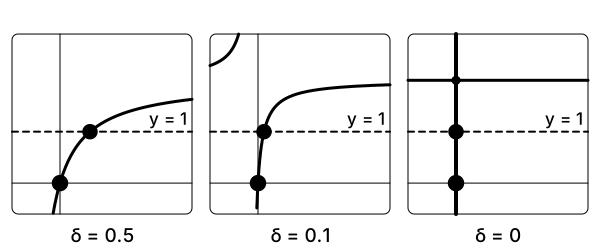
The curve is y(x + δ) = 2x, of size 2. At δ = 0 this becomes x(y − 2) = 0, two lines. The line y = 2 is what is left of the old curve. The line x = 0 is new: it runs from the pin up through the wall. That is the bubble at the pin. Sizes still add up: 1 + 1 = 2.
Why must a bubble grow? On the curve, the pin and the mark come together. In the plane they can’t, because the mark stays on a wall that misses the pin. So the short stretch of curve between them must still climb from the pin to the wall. Zoom in with t = δτ, and the height is 2τ ÷ (τ + 1) for every δ: the same climb, squeezed into a shorter and shorter stretch of addresses. In the limit the stretch shrinks to the one address 0, and its picture stays behind as a new piece through the pin. It reaches the wall, so it can’t be a single point. Like every piece that breaks off, it is rational.
The paper’s Lemma 2.1, which it calls Bend-and-Shatter, does this at k pins at once. Each pin gets its own mark, its own wall, and its own knob to keep the mark there. Then the curve breaks at every pin: k rational pieces, one through each pinned point. The paper also checks that each mark can be kept on its wall. Part 13 counts what each pin costs.
References参考資料
In one lineひとことで
決めたピンで折りたいなら、ピンを通らない壁に印を乗せたまま、印をピンに寄せます。
Bend-and-Break(第 11 回)は、曲線が折れることを約束します。でも、どこで折れるかは決められません。2025 年の論文は、選んだピンのすべてで折りたいのです。そのための道具が、印と壁です。
平面の小さな例で見ます。曲線の点には、曲線の上の住所 t と、平面の上の位置があります。小さな数 δ > 0 を決めて、住所 t の点を (t, 2t ÷ (t + δ)) に置きます。住所 0 の点は、いつも (0, 0) にあります。これがピンです。住所 δ の点は、高さ 2δ ÷ 2δ = 1 にあり、壁 y = 1 の上にいます。これが印です。壁はピンを通りません。
ここで δ を 0 に近づけます。印の住所は、ピンの住所に寄っていきます。でも印の位置は、壁の上のままです。
この曲線の式は y(x + δ) = 2x で、大きさは 2 です。δ = 0 にすると、式は x(y − 2) = 0 になり、2 本の直線に分かれます。直線 y = 2 は、もとの曲線の残りです。直線 x = 0 は、新しく出てきました。ピンから始まり、壁を通って上にのびています。これが、ピンに生えたかけらです。大きさも、1 + 1 = 2 で合っています。
なぜ、かけらが生えるのでしょうか。曲線の上では、ピンと印がくっついていきます。でも平面の上では、くっつくことができません。印は、ピンを通らない壁の上にいるからです。だから、2 つのあいだの短い部分は、それでもピンから壁まで登らなければなりません。t = δτ として拡大すると、高さは、どの δ でも 2τ ÷ (τ + 1) です。同じ登り坂が、どんどん短い住所の区間に押し込まれていきます。最後には、その区間は住所 0 の 1 点に縮みます。そして、その坂の形が、ピンを通る新しいかけらとして残ります。かけらは壁まで届くので、1 点に縮むことはできません。折れたかけらは、いつも有理曲線です。このかけらもそうです。
論文の補題 2.1 は、Bend-and-Shatter(曲げて粉々にする)という名前で、これを k 本のピンで同時に行います。ピンごとに、自分の印と自分の壁と、印を壁に乗せておく専用のつまみを 1 本ずつ用意します。すると、曲線はすべてのピンで折れます。ピンの点を 1 つずつ通る、k 個の有理曲線のかけらが出てきます。論文は、どの印も壁に乗せておけることも確かめています。ピン 1 本にかかる費用は、第 13 回で数えます。