Over the complex numbers, a circle is a sphere複素数で見ると、円は球になる
Seriesシリーズ · Part 5 of 175 / 17
All parts ↓すべての回 ↓Bend-and-Shatter, made simpleやさしい Bend-and-Shatter
Goal: ゴール:Learn how one movable curve tells you which simple curves fill a space, and why the best bound is n + 1.動ける曲線 1 本から、空間を編む単純な曲線を言い当てるしくみと、上限が n + 1 になる理由を知る。 Why it’s interesting →なぜ面白いのか →
In one lineひとことで
A curve with no holes is a sphere in disguise, and those are the rational curves.
The paper works with complex numbers, where every polynomial equation has a solution (Part 2). A complex number t = a + b i is made of two real numbers, a and b. So a curve, whose points need one complex number as an address, looks like a surface when you draw it with real numbers.
Take the circle x² + y² = 1. One number t draws it:
x = (1 − t²) / (1 + t²), y = 2t / (1 + t²)
Real values of t give the circle you know. t = 0 gives (1, 0), and as t grows large in either direction, the point gets close to (−1, 0). Now let t be any complex number. Its addresses fill a whole plane. However t goes far away, the point gets close to the same spot, (−1, 0). So the plane needs one more point, t = ∞. With it, the plane closes up like a cloth tied at the top, and becomes a sphere. (Two values, t = i and t = −i, make 1 + t² zero. They land on the circle’s two points at infinity, which the paper’s spaces include.)
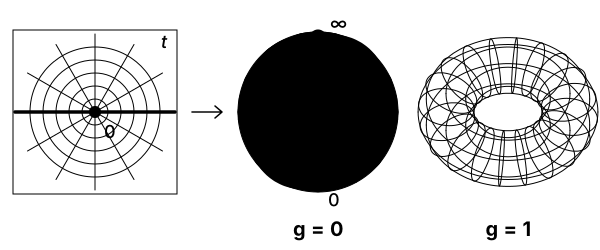
So over the complex numbers, a circle is a sphere. The ordinary circle is only one loop on it: the loop of real t.
Every curve that one number t can draw works the same way. It is the t-sphere placed into the space, perhaps pinched or crossing itself in places. These are the rational curves from Part 1.
Compare a curve that one t can’t draw. Over the complex numbers, again with its point at infinity, y² = x³ + 1 is a donut with one hole. The number of holes is called the genus g. A curve with holes can never be drawn by one t, so rational curves are exactly the curves with no holes. To count fairly, first smooth out sharp points and places where the curve crosses itself. For example, y² = x³ has a sharp point at (0, 0), yet t draws all of it as (t², t³).
Holes matter for the rest of the series. The paper starts from a curve C that may have holes, and Part 7 shows that each hole costs knobs.
References参考資料
In one lineひとことで
穴のない曲線は、形を変えた球です。それが有理曲線です。
論文は、複素数で考えます。複素数では、どんな多項式の方程式にも答えがあります(第 2 回)。複素数 t = a + b i は、a と b という 2 つの実数でできています。曲線の点は、複素数 1 つで場所を言えます。だから実数で描くと、曲線は面に見えます。
円 x² + y² = 1 を例にします。1 つの数 t で、次のように描けます。
x = (1 − t²) / (1 + t²)、y = 2t / (1 + t²)
t が実数なら、いつもの円です。t = 0 なら (1, 0) です。t をどちら向きに大きくしても、点は (−1, 0) に近づきます。次に、t を複素数にします。t は平面全体を動けます。t がどの向きに遠くへ行っても、点は同じ (−1, 0) に近づきます。そこで、平面に t = ∞ という点を 1 つ足します。すると平面は、風呂敷の四すみをてっぺんで結んだように閉じて、球になります。(t = i と t = −i では、1 + t² が 0 になります。この 2 つは、円の無限の遠くの 2 点に行きます。論文の空間は、無限の遠くの点も含んでいます。)
つまり、複素数で見ると、円は球です。いつもの円は、その上の 1 本の輪にすぎません。実数の t が描く輪です。
1 つの数 t で描ける曲線は、どれも同じです。t の球を、空間に置いたものです。ところどころでつぶれたり、自分と交わったりすることはあります。これが、第 1 回の有理曲線です。
1 つの t では描けない曲線と比べてみます。複素数で見て、無限の遠くの点も足すと、y² = x³ + 1 は穴が 1 つのドーナツです。穴の数を、種数 g といいます。穴のある曲線は、1 つの t ではけっして描けません。だから有理曲線は、ちょうど穴のない曲線です。ただし穴を数える前に、とがった点や、自分と交わる点をならしておきます。たとえば y² = x³ は (0, 0) でとがっていますが、(t², t³) で全体を描けます。
穴は、このシリーズでこのあとも大事です。論文が出発点にする曲線 C には、穴があってもかまいません。第 7 回では、穴 1 つごとにつまみが減ることを見ます。