In characteristic p, a curve can be wrapped without new holes標数 p なら、巻きつけても穴が増えない
Seriesシリーズ · Part 9 of 179 / 17
All parts ↓すべての回 ↓Bend-and-Shatter, made simpleやさしい Bend-and-Shatter
Goal: ゴール:Learn how one movable curve tells you which simple curves fill a space, and why the best bound is n + 1.動ける曲線 1 本から、空間を編む単純な曲線を言い当てるしくみと、上限が n + 1 になる理由を知る。 Why it’s interesting →なぜ面白いのか →
In one lineひとことで
When holes block you, change the numbers. In characteristic p, wrapping adds no holes.
Part 8 hit a wall. Over the complex numbers, wrapping a curve with many holes adds holes as fast as it adds −K·C. In 1979, Shigefumi Mori got past it by changing the numbers themselves.
In characteristic p, where p is a prime, adding 1 to itself p times gives 0. Clock arithmetic with p hours is the simplest example. The paper needs more: a number system of characteristic p in which every polynomial equation has a solution, as with the complex numbers in Part 2. Such a system exists for every prime p.
The wrapping below depends on one rule. In characteristic p, (a + b)^p = a^p + b^p, because the middle coefficients of the expansion are multiples of p. For p = 3, (t − 2)³ = t³ − 6t² + 12t − 8. The 6 and the 12 become 0, which leaves t³ − 2³.
Now wrap the curve with the Frobenius map, which replaces t with t^p. A ruler that crossed the curve at t = a now crosses it where t^p = a. Write a = d^p. Then t^p − a = (t − d)^p, so there is one solution, t = d, counted p times. Every crossing count is multiplied by p, and −K·C with it. But points still match one to one, so the wrapping curve keeps the same g holes.
Repeat this m times to wrap p^m times. Part 7’s estimate becomes knobs ≥ p^m(−K·C) + n(1 − g). The hole term stays fixed, so the knobs grow without limit.
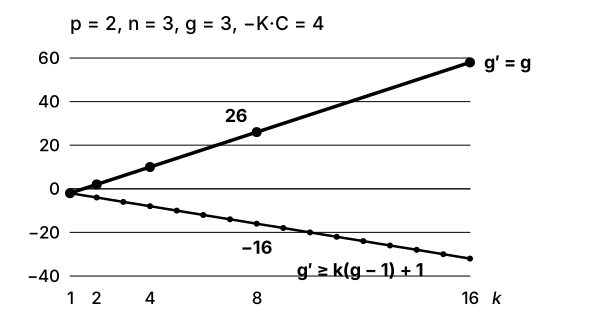
Take Part 8’s curve again, with n = 3, g = 3, −K·C = 4, and let p = 2. Wrapping it 8 times with Frobenius gives at least 32 + 3 × (1 − 3) = 26 knobs. Ordinary wrapping gave at most −16.
The paper does exactly this in the proof of its Theorem 1.1. It writes the estimate as d_m ≥ p^m(−K_X·C′) − g·dim X, leaving out the + n, which makes no difference once m is large. It proves the theorem in characteristic p first. For the complex numbers, it reuses Yoichi Miyaoka and Mori’s 1986 argument, which carries the problem to characteristic p and back.
References参考資料
- Jovinelly, Lehmann, Riedl: Optimal bounds in Bend-and-Break (arXiv:2509.08065)
- Mori: Projective manifolds with ample tangent bundles (Annals of Mathematics, 1979)
- Miyaoka, Mori: A numerical criterion for uniruledness (Annals of Mathematics, 1986)
- Lehmann: Rational curves and the canonical divisor (PRIMA 2021, lecture 2)
In one lineひとことで
穴がじゃまなら、数の世界を取り替えます。標数 p では、巻きつけても穴が増えません。
第 8 回では、壁にぶつかりました。複素数では、穴の多い曲線を巻きつけても、−K·C と同じ勢いで穴が増えます。1979 年、森重文さんは、数の世界そのものを取り替えて、この壁を越えました。
標数 p の世界では、p は素数で、1 を p 回足すと 0 になります。いちばん簡単な例は、p 時間で 1 周する時計の算数です。ただ、論文にはもっと大きな数の世界が要ります。標数が p で、第 2 回の複素数のように、どんな多項式の方程式にも解がある世界です。そういう世界は、どの素数 p にもあります。
このあとの巻きつけで使うのは、次の式です。標数 p の世界では、(a + b)^p = a^p + b^p が成り立ちます。展開したときの真ん中の係数が、すべて p の倍数になって消えるからです。p = 3 なら、(t − 2)³ = t³ − 6t² + 12t − 8 です。6 と 12 が 0 になり、t³ − 2³ が残ります。
そこで、t を t^p に置き換えて、曲線を巻きつけます。これをフロベニウス写像といいます。もとの曲線と t = a で交わっていたものさしは、こんどは t^p = a のところで交わります。a = d^p と書くと、t^p − a = (t − d)^p です。答えは t = d の 1 つだけで、p 重に数えます。だから交わる回数はどれも p 倍になり、−K·C も p 倍です。それでいて、点と点は 1 対 1 のままです。巻きつける側の曲線も、穴は g 個のままです。
これを m 回くり返すと、p^m 重に巻きつけられます。第 7 回の見積もりは、つまみ ≥ p^m(−K·C) + n(1 − g) になります。穴の項は変わらないので、つまみはいくらでも増やせます。
第 8 回の曲線で確かめます。n = 3、g = 3、−K·C = 4 で、p = 2 とします。フロベニウスで 8 重に巻きつけると、つまみは少なくとも 32 + 3 × (1 − 3) = 26 本です。ふつうの巻きつけでは、多くても −16 でした。
論文は、定理 1.1 の証明でまさにこれを使います。見積もりは d_m ≥ p^m(−K_X·C′) − g·dim X と書かれています。+ n を省いた形ですが、m が大きければ違いはありません。論文は、まず標数 p で定理を証明します。複素数のときは、宮岡洋一さんと森さんの 1986 年の議論を使います。問題を標数 p に移して解き、もとに戻す議論です。
References参考資料
- Jovinelly, Lehmann, Riedl:Optimal bounds in Bend-and-Break(arXiv:2509.08065)
- 森重文:Projective manifolds with ample tangent bundles(Annals of Mathematics、1979 年)
- 宮岡洋一、森重文:A numerical criterion for uniruledness(Annals of Mathematics、1986 年)
- Lehmann:Rational curves and the canonical divisor(PRIMA 2021、講義 2)